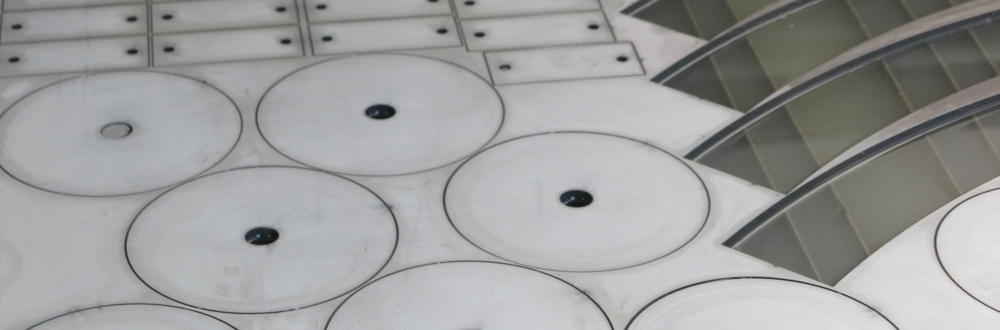
Sheet metal cutting
Sheet metal coil cutting
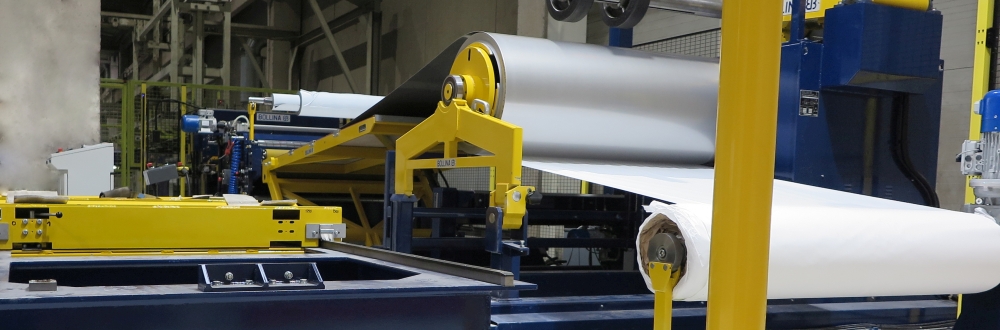
Stainless steel (sheet metal) of various types and thicknesses is delivered in coils, which are mounted onto a decoiler in order to be cut. This is the first step in our production process. The cutting process is carried out according to precisely defined parameters and includes several key stages:
Unrolling, straightening, and cutting
The decoiler unrolls the sheet metal and feeds it through a straightener towards the cutting line. The shears then cut the metal into preset dimensions, tailored to the next stages of the production process and final product requirements.
Application of protective film
When needed, a protective film is applied to the metal to protect the material from damage during subsequent production stages.
Storage
The cut pieces either proceed directly into production or are stored in our vertical sheet metal storage tower where they await the next steps in the production process.
The automated sheet metal cutting process ensures optimal material utilization, minimal handling, and a smooth and efficient production flow.
2D laser cutting with fiber technology
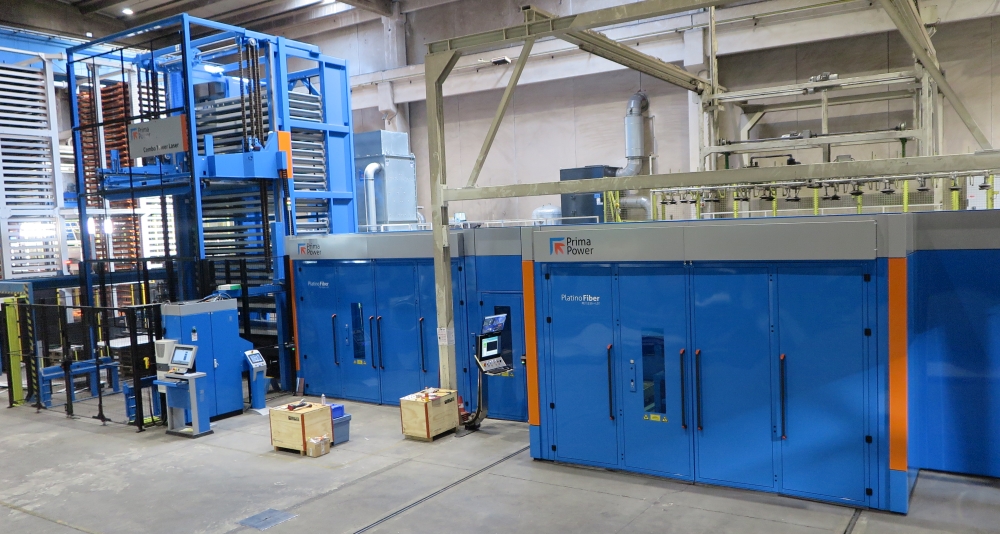
In our production process, we use a state-of-the-art 2D laser cutting machine that enables precise cutting of various shapes (including highly complex designs).
Advantages and cutting capacity:
| Advantages | - extremely low cutting tolerance, ensuring high quality and repeatability - precise cuts and minimal heat-affected zone (HAZ) eliminate the need for additional mechanical edge finishing - CNC control enables fast and automated operation - optimized cutting reduces costs and minimizes waste - different types of sheet metal of various thicknesses, simple design adjustments without tool changes - energy-efficient equipment |
| Suitable materials | all types of steel, aluminum and aluminum alloys, iron, and other materials; square, round, and rectangular pipes |
| Max. cutting dimension | 1500 x 3000 mm |
| Max. material thickness | 25 mm |
| Precision | +/- 0.05 mm |
Robot and COMBO TOWER storage system
Cut sheet metal parts are transferred using an automated system with an integrated robot. The robot picks up the cut pieces and automatically sorts and stores them in the COMBO TOWER storage system, enabling fast, precise, and safe storage. Size limitations of the cut pieces must be taken into account.
| Advantages of the automated storage system | - faster and more precise material flow - safe storage with minimal risk of damage - optimized space utilization - smooth production flow with minimal manual handling - integrated robot and automated storage system enable laser operation even without an operator |
| Min. size (cut parts) | 200 x 200 mm |
| Max. size (cut parts) | 1500 x 3000 mm / 500 kg |
| Capacity (storage tower) | 25 pallets |
| Total load capacity (pallets) | 75 tons |
Storage tower for cut sheet metal
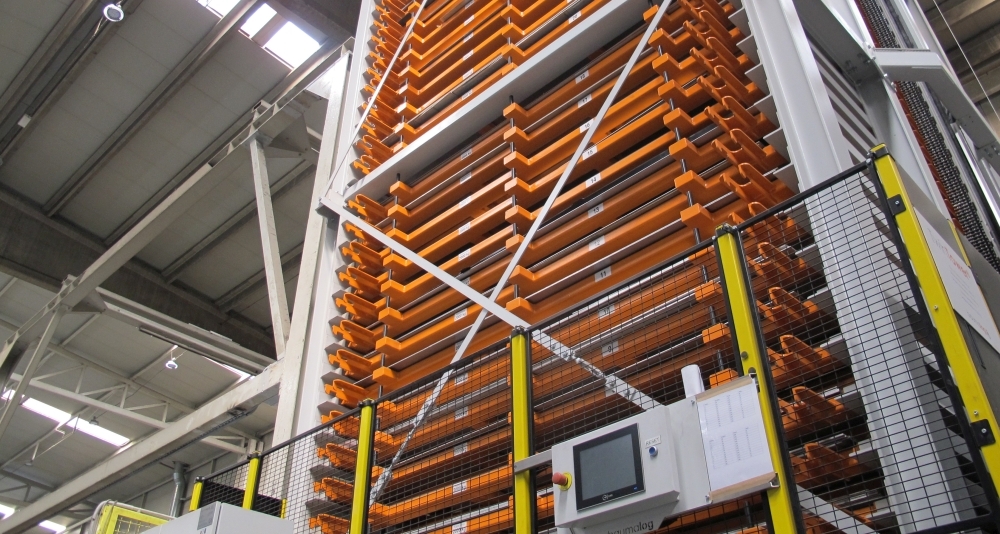
In addition to the robot and COMBO TOWER storage system, we also have a separate storage tower for cut sheet metal.
| Advantages | - pull-out shelves enable fast and easy handling of cut metal sheets - improved accessibility and less additional material handling - real-time inventory overview - max. factory space utilization |
| Capacity (storage tower) | 74 pallets |
| Total load capacity (pallets) | 148 tons |
Robotic laser cell with integrated 3D machine vision
Our production is equipped with a modern robotic laser cell that combines fiber laser cutting and 3D machine vision. By comparing the captured 3D scan with the CAD model (STP file), the system automatically corrects the cutting path, ensuring accuracy and repeatability even for parts with geometric deviations.
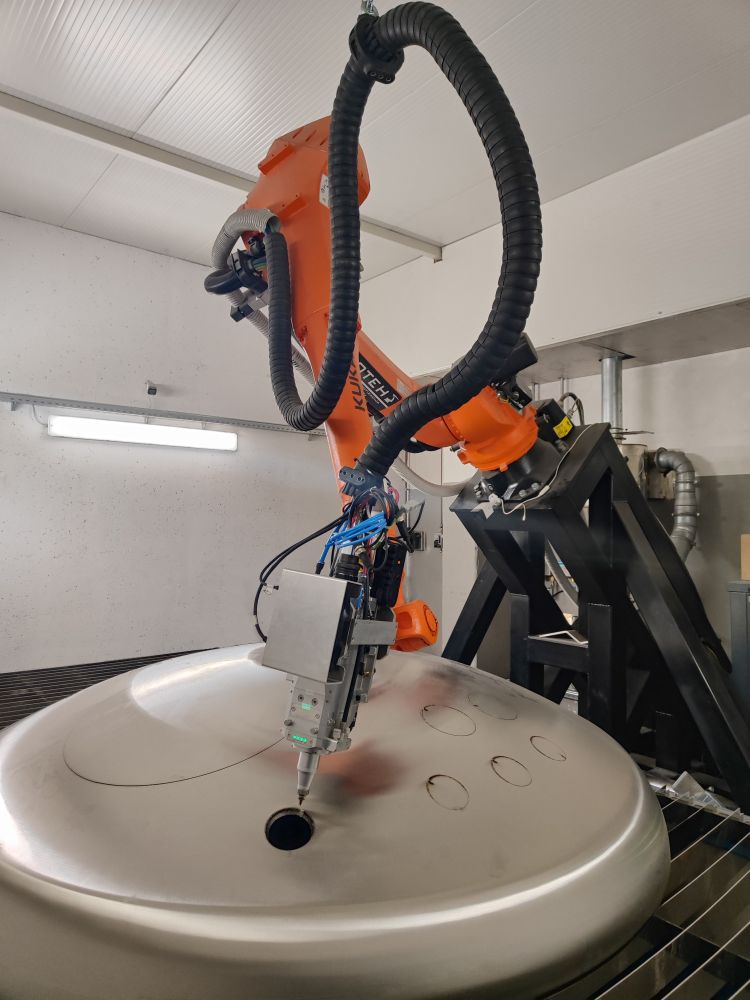
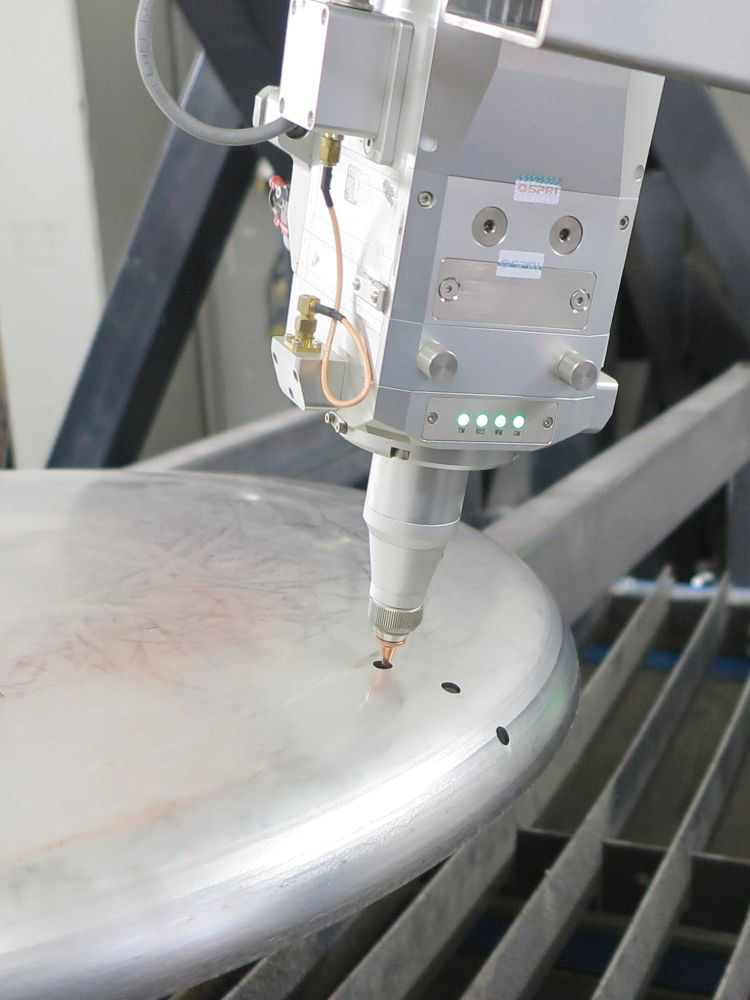
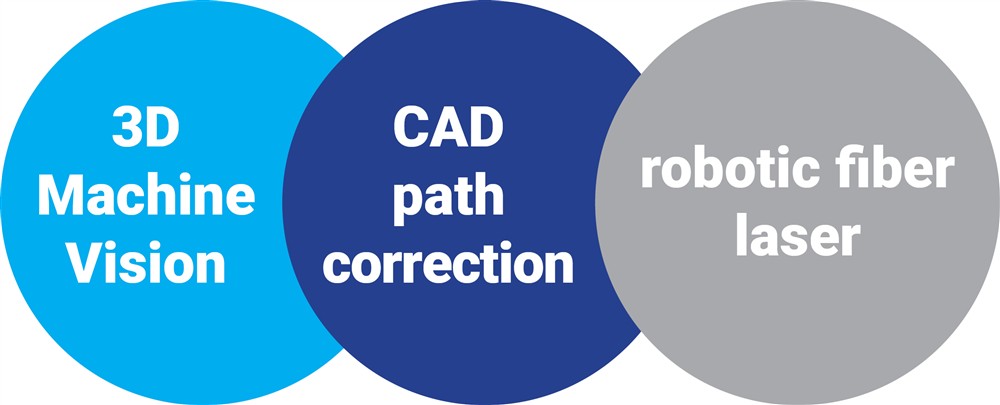
The system is an adaptive manufacturing platform that integrates several technologies: robotic fiber laser + 3D machine vision + CAD based path correction.
Operating principle:
1) A 3D camera scans the actual workpiece.
2) The system compares the real geometry of the workpiece with the CAD (STP) model.
3) The system automatically corrects the robot's cutting path.
4) The fiber laser cuts with the appropriate geometry (including weld bevels).
Advantages and capacity:
| Advantages of laser cutting with 3D machine vision | - adaptive processing (compensation of deviations in real parts) - high repeatability regardless of variations in incoming semi-finished products - reduced manual finishing (grinding, edge preparation) - shorter edge preparation time for welded fittings, especially on tank bottoms (up to 70 % shorter) - lower operator dependency - more cost-efficient production |
| Max. workpiece dimensions | 2000 × 4000 × 1000 mm (W×L×H) |
| Max. tank bottom diameter | 3000 mm |
| Max. workpiece thickness | 25 mm |
| Max. workpiece thickness – bevel cutting | up to 20 mm |
| Examples of workpieces | - tank bottoms and lids - large profiles (round, square, UPN-profiles, I-profiles) - circular steel plates or rings (flanges) - electrical cabinets - tank door frames |
Added value for the customer:
- higher product quality and consistency,
- shorter delivery times.
Comparison of sheet metal cutting methods:
| Classic CNC or laser cutting | Robotic laser cell with integrated 3D machine vision |
| - requires precise clamping - requires prior preparation of edges for welding - performs the cut along a fixed path - poor deviation tolerance |
- enables processing without clamping (which is time-consuming) - shorter edge preparation time for welding - automatic cutting path correction - full repeatability of incoming semi-finished products - higher level of automation |
Laser tube cutting
Laser tube cutting is a high-tech and precise method that enables fast and accurate cutting of tubes with various diameters and wall thicknesses.
| Advantages | - clean, smooth cuts reduce the need for additional mechanical edge finishing - CNC control enables fast and repeatable cutting - minimal heat-affected zone (HAZ), which prevents changes in the mechanical properties of the material - precisely programmed cutting reduces material waste |
| Suitable materials | stainless steel, iron, aluminum |
| Max. tube length | 6,000 mm |
| Max. tube diameter | ∅ 220 mm |
| Max. tube thickness | 10 mm |
CNC water jet cutting
Abrasive water jet cutting is an environmentally friendly process, as it produces no harmful fumes or waste requiring special disposal. The cutting force comes from a high-pressure jet of water mixed with quartz sand, enabling a cold cut without a heat-affected zone (HAZ). This makes the method ideal for materials sensitive to temperature. It’s especially suitable for thicker materials and for cutting complex shapes.
The high-pressure abrasive water jet (operating pressure range: 0–4000 bar) removes the base material through erosion, delivering precise cuts. The A-Jet cutting head is controllled with a computer software. The adjustable cutting angle (0°–60°) enables various cuts, including circular and curved shapes.
Advantages and cutting capacity:
| Advantages of CNC water jet cutting | - extremely versatile (wide range of materials and thicknesses) - capable of producing complex shapes - cold cutting with no thermal impact, preventing deformation or changes in material properties - extremely precise computer-controlled cutting - high-quality edges, reducing the need for additional treatment - little material loss |
| Suitable materials | stainless steel, aluminum (Al), copper (Cu), structural steel (S235), rubber, plastic, stone, brass, plexiglass... |
| Max. cutting dimension | 2000 x 6000 mm (x,y) |
| Max. material thickness | 200 mm |
| Precision | +/- 0.2 mm |